Some losses are so significant they divide your life into before and after.
They alter the landscape of your days. They change how you think, how you pray, how you move through the world. Even when life continues, something inside you knows it is not quite the same.
I’ve been walking through one of those losses.
In recent months, I have found myself grieving more than I ever imagined possible. Some days the grief is quiet. Other days it rises unexpectedly and catches me completely off guard. It has sent me searching for answers, not only about grief itself, but about what healing really means.
What I am learning is this:
Grief isn’t a sign something is wrong with you
For a long time, I thought something was wrong with me because I always seemed to be grieving something. I truly thought this was all my fault, and it was a terrible thing. As if I was causing all this loss. Now, I realize I kind of am…but it’s not a bad thing.
Grief is not evidence of dysfunction. It is evidence of attachment. The depth of our grief often reveals the depth of our love.
People sometimes speak about healing as though it means reaching a place where loss no longer affects us. I don’t believe that’s true. I think healing means learning to carry love and loss together.
I used to ask myself, Why am I grieving all the time? Lately, I think I’ve found the answer. It’s because I’m loving all the time.
When you love deeply, there is always the possibility of grief. Every relationship, every precious season, every person we cherish carries the risk of loss. The only way to avoid grief altogether would be to stop loving, and that is such an empty way to live.
So I will continue to love hard even though sometimes, like right now…it is excruciating. I will continue to open my heart, even knowing that grief may follow.
There are moments when sorrow feels so large I feel as if it is threatening to swallow me whole, but I have learned that grief is not stronger than God. He holds me steady when the waves rise. He carries me when I am weary. And He continually reminds me that love is still worth risking everything for.
Grief arrives without checking your calendar
This week I was at my dentist’s office for a routine cleaning, something I do every three months. Diana, my hygienist, is the same sweet person I see every visit. She’s one of those rare people who is not only excellent at what she does, but also carries a genuine kindness that makes people feel seen.
During our conversation, she said something that touched a tender place in my heart, and before I knew it, tears were streaming down my face right there in the dental chair.
I finally said, “I’m sorry. I just can’t hold this in. It’s so heavy…”
And then I told her the whole story.
Diana is the kind of person who doesn’t hesitate to reach across the room and offer a hug. She always seems to know the right thing to say.
I left that appointment grateful for people like her. The kind of people who are willing to stop what they’re doing, enter someone else’s pain for a moment, and remind them they aren’t alone. I hope I can be that kind of person for others as much as God allows me to be.
That experience reminded me of something else I’ve learned about grief…it doesn’t care where you are or what you’re doing.
It doesn’t wait until you’re home, or you’re alone, or it’s convenient. It’s suddenly there whether you like it or not. It roars when it wants to.
For a long time, I apologized for that. Now I’ve learned to simply let it come when it comes.
Grief isn’t rude.
It’s human.
And I’ve become convinced that the cost of holding grief in is often far greater than the discomfort of letting it out. Unexpressed sorrow has a way of showing up somewhere else: in our bodies, our exhaustion, our anxiety, and our relationships.
So when the tears come, I let them come.
Even if my makeup doesn’t survive or I have to leave the room to get myself together.
I’ve learned that healing never comes from suppressing grief. More often, it comes from acknowledging it, feeling it, and allowing it to move through us instead of burying it beneath the surface.
What we refuse to feel doesn’t disappear
It simply finds another place to live.
Many of us are carrying physical burdens that began as emotional ones. Stress, grief, anxiety, disappointment, and unresolved pain have a way of showing up in our bodies. What starts in the heart and mind often eventually affects our physical well-being.
Tears are not weakness. They are release. Sometimes they’re medicine.
I’ve learned that if I want to heal, I have to allow myself to feel. I have to acknowledge what hurts, think about it honestly, pray through it, talk about it, cry about it, write about it, or move my body and work some of it out. What I cannot do is pretend it isn’t there.
There have been times over the past few months when I’ve tried to soothe my pain in less healthy ways. Nothing dramatic. Just reaching for comfort food too often and trying to numb feelings that really needed to be processed. The problem is that numbing doesn’t heal anything. It only delays the work that needs to be done.
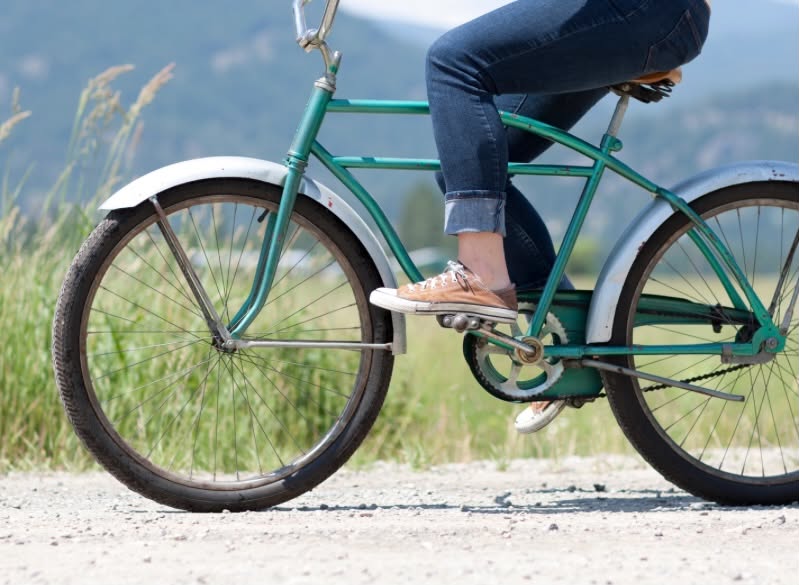
This past week, I decided it was time to make a different choice. I started riding my bike again. I started walking again. I even told Judi to bring her workout clothes on our tour this weekend because I’m going to need to burn off some feelings, and she’s welcome to come along when I go to the hotel gym.
Sometimes grief needs tears. Sometimes it needs conversation. Sometimes it needs prayer. And sometimes it needs movement. There is something healing about getting outside, feeling the sun on your face, moving your body, and allowing some of the emotional weight you’ve been carrying to loosen its grip.
I’m learning that healing is not passive. It requires honesty, courage, and participation. It asks us to stop running from our pain and begin walking through it, trusting that God will meet us there.
The right people won’t be frightened by your tears
Many of us spend years worrying that we’re too much.. We apologize for our feelings, minimize our pain, and try to present a version of ourselves that seems more acceptable and less complicated.
Yet some of the most healing moments in life happen when we stop pretending.
I’ve discovered that genuine love is remarkably patient. It doesn’t grow irritated because you’re still hurting. It doesn’t demand that you “move on” according to some arbitrary timeline.
I am deeply thankful for the people in my life who are willing to hear me say for the 568th time how much something hurts and then pray for me for the 568th time as well. They never make me feel like a burden. They remind me that healing is rarely linear and that some losses take a long time to process.
Their presence has taught me something important…the safest people are not always the ones who know exactly what to say. Often, they are the ones who simply stay. They listen. They care. They pray. And in doing so, they become a tangible expression of God’s love in our lives.
Healing doesn’t mean the grief goes away
This may be the most important thing I’m learning.
For a long time, I thought healing meant arriving at a place where the pain no longer touched me. I imagined there would come a day when certain losses would no longer ache, memories would no longer sting, and wounds would finally be behind me.
Now I see healing differently.
I think healing is learning how to build a meaningful, beautiful life while still carrying some hurts. It is discovering that joy and sorrow can coexist, that gratitude and grief can occupy the same heart, and that a person can be deeply healed while still feeling the impact of significant loss.
The grief changes over time. It softens. It becomes less consuming. It loosens its grip on our daily lives. What once felt impossible to carry gradually becomes lighter, not because the loss mattered less, but because we have grown stronger.
Some losses become part of our story forever. They shape us, teach us, humble us, and deepen our compassion. We do not erase them, and we do not pretend they never happened.
A scar is not proof that a wound is still open. It is evidence that healing has taken place. In much the same way, some grief remains visible in our lives, not because we are broken, but because we loved deeply and lived fully.
I no longer measure healing by the absence of pain. I measure it by my ability to keep loving, hoping, serving, and finding beauty in life even while carrying the the pain of loss.

“The only way to avoid grief altogether would be to stop loving, and that is such an empty way to live.” How very true. There is no “getting over it”. Less intense as years go by perhaps, but never totally.
thank you for the enlightening talk regarding grief and the many aspects of it.it opens the door about areas of more understanding of grief and how it can affect you. I feel more settled now.